
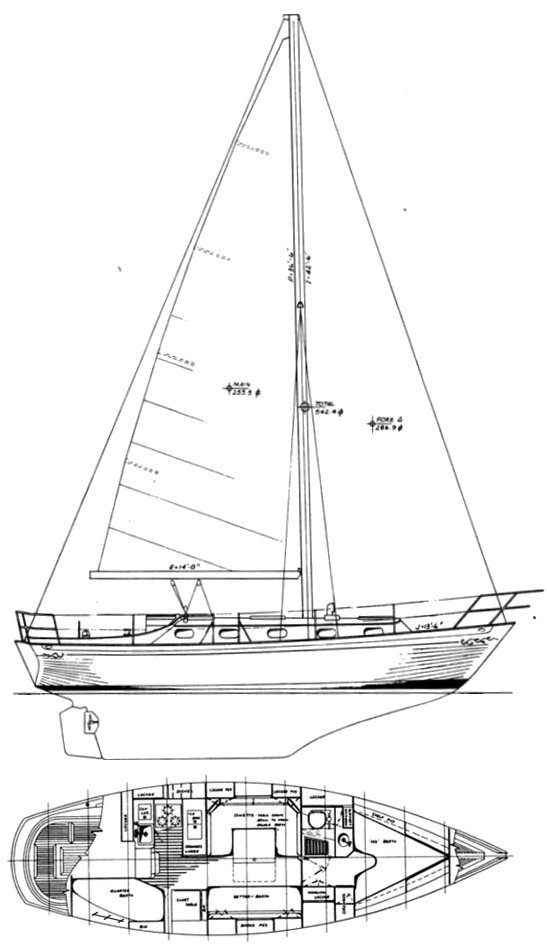
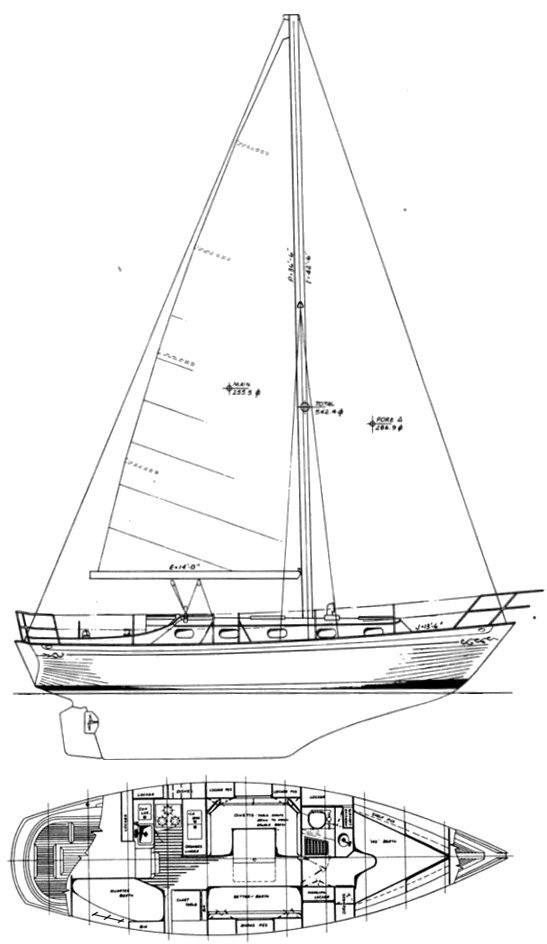
La Sirena is a 1980 Rafiki 35, hull number 29 – is a traditional heavy-displacement, full-keel cruising sailboat designed by Canadian naval architect Stan Huntingford and built in Taiwan.
She comes from a very different philosophy of yacht design from most modern production sailboats. The Rafiki 35 wasn’t designed primarily around marina accommodation, light-air speed or maximizing interior volume. She was conceived as a compact, strongly built cruising boat capable of carrying stores, equipment and her crew over considerable distances.
Only around 32 Rafiki 35s are recorded as having been built, making the design surprisingly rare.
At 35 feet, La Sirena isn’t a particularly large yacht.
But she is a lot of boat.
La Sirena — Principal Specifications & Equipment
| La Sirena — 1980 Rafiki 35 | |
|---|---|
| Builder | Lien Hwa Industrial Corp., Taiwan |
| Designer | Stan Huntingford |
| Year | 1980 |
| Design | Rafiki 35 |
| Construction | Fiberglass cruising hull with extensive teak |
| Rig | Cutter |
| Hull form | Heavy-displacement cruising hull |
| Keel | Full/long keel with protected rudder |
| LOA | Approx. 34 ft 8 in |
| Beam | Approx. 10 ft 10 in |
| Draft — La Sirena | Approx. 5 ft |
| Displacement | Approx. 16,500 lb |
| Ballast | Approx. 6,800 lb |
| Ballast/Displacement | Approx. 41% |
| Sail Area | Approx. 525 sq ft |
| Mast Height — La Sirena | Approx. 52 ft |
| Comfort Ratio | Approx. 36 |
| Capsize Screening Formula | Approx. 1.70 |
| Theoretical Hull Speed | Approx. 7 knots |
| Typical Cruising Speed | Approx. 5–6 knots |
| Engine | Volvo Penta 3-cylinder marine diesel |
| Gearbox | Volvo Penta MS2B |
| Propulsion | Conventional shaft drive with dripless seal and fixed propeller |
| Fuel Filtration | Dual Racor filtration system |
| Fuel Polishing | Dedicated onboard fuel-polishing system |
| Extended Fuel Capacity | Additional 70-gallon auxiliary fuel tank |
| Primary Anchor | 20 kg Rocna |
| Primary Rode | Approx. 350 ft of 5/16″ G4 high-test chain |
| Anchor Snubber/Bridle | Mantus bridle and snubber system |
| Windlass | Heavy-duty anchor windlass; powered retrieval with manual/free-fall lowering arrangement |
| VHF / AIS | Standard Horizon Matrix AIS+ |
| Long-Range Radio | ICOM IC-M802 HF/SSB marine radio |
| HF Data Communications | Pactor modem |
| Radar | Furuno marine radar |
| Wind Instruments | Nexus / Nexus NX wind system with masthead transducer |
| Speed / Water Temperature | Airmar ST850 paddlewheel speed/temperature transducer |
| Navigation Displays | Furuno and Nexus instrumentation |
| Autopilot | Two independent autopilot systems |
| Steering | Wheel steering with mechanically accessible steering gear |
| Compass | Conventional marine steering compass/navigation equipment |
| Electrical System | 12V DC system with separate battery banks, 2 x 210ah House Batteries and 1/2/BOTH battery selection |
| Solar | Solar charging system for extended operation away from shore power |
| Bilge Pumps | Multiple electric bilge pumps with manual and automatic operation |
| Shower Sump | Dedicated 500 GPH sump pump |
| Ventilation | Powered engine-room bilge/ventilation blower |
| Fresh Water System | Pressurized Jabsco diaphragm pump with accumulator tank |
| Hot Water | Seaward 6-gallon marine water heater |
| Cockpit Shower | Hot and cold pressurized cockpit shower |
| Refrigeration | CoolBlue R134a cold-plate refrigeration system |
| Watermaker | Reverse-osmosis watermaker, Village Marine-type; recommissioning or replacement planned |
| Cabin Heating | Dickinson diesel heater |
| Dinghy Handling | Stern dinghy davits |
| Emergency Equipment | 406mhz distress beacon, emergency leak-control equipment and associated offshore safety gear |
| Technical Library | Extensive ship’s library including equipment manuals, diesel/communications/navigation references and approximately 46 years of vessel documentation |
Ground Tackle
La Sirena’s ground tackle deserves more than a single line in the specifications because it is one of the systems around which the intended cruising plan has deliberately been built.
The primary anchor is a 20 kg Rocna, connected to approximately 350 feet of 5/16-inch G4 high-test chain.
The chain is complemented by a Mantus anchor bridle/snubber system. Once anchored, the bridle takes the working load rather than leaving the boat hanging directly from the windlass. The nylon component also introduces elasticity into what would otherwise be an almost completely non-stretch chain rode, reducing shock loading as La Sirena pitches or surges in stronger conditions.
This is particularly important for the way I intend to use the boat. La Sirena isn’t being equipped around moving from marina to marina. I expect anchoring to be the normal condition and marina stays to be occasional ones.
For that reason I regard the Rocna, G4 chain, windlass and Mantus bridle collectively as a primary cruising system, rather than simply anchor equipment.
Navigation & Communications
La Sirena’s navigation and communications installation is an interesting mixture of traditional equipment and several generations of marine electronics.
At its heart are conventional navigation instruments backed by Furuno radar, Nexus/NX instrumentation, masthead wind instrumentation and an Airmar ST850 speed and water-temperature transducer.
Radar is particularly valuable for the cruising I have in mind. The Pacific Northwest can combine darkness, rain, fog, islands, logs, fishing traffic and large commercial vessels within a surprisingly small piece of water.
La Sirena also has two autopilot systems.
For a boat intended to be sailed extensively short-handed or single-handed, this is a particularly important form of redundancy. An autopilot isn’t simply a convenience when sailing alone. It effectively becomes another member of the crew, allowing the person aboard to navigate, trim sails, prepare food, check the engine, investigate problems and rest during longer passages.
Having two systems means failure of one does not necessarily remove that capability.
VHF, AIS & Long-Range Communications
Short-range communications are handled by a Standard Horizon Matrix AIS+ VHF.
The Matrix provides conventional marine VHF communications together with AIS functionality, adding another source of information about commercial and recreational traffic around the boat.
But La Sirena’s communications capability extends considerably farther than VHF range.
She also carries an ICOM IC-M802 marine HF/SSB radio.
The M802 gives La Sirena genuine long-range radio capability independent of cellular coverage and local VHF infrastructure. HF/SSB has traditionally been one of the principal long-distance communications systems aboard offshore cruising yachts.
Connected with the communications installation is a Pactor modem, providing the ability for compatible digital data communications over HF radio.
Together, VHF, AIS, HF/SSB and Pactor give La Sirena a communications installation much more characteristic of a long-range passagemaking boat than a typical coastal 35-footer.
Modern satellite communications can complement those systems rather than necessarily replacing them. Starlink is also fitted for main-easy to go data.
Fuel Capacity & Range
Another particularly significant modification is La Sirena’s extended fuel capacity.
In addition to her normal fuel installation, she carries an additional 70-gallon auxiliary fuel tank.
Combined with the relatively economical three-cylinder Volvo Penta diesel, that substantially increases the potential motoring and motor-sailing endurance of the boat.
The fuel installation is supported by dual Racor filtration and an onboard fuel-polishing system.
That combination is important. Carrying more fuel isn’t particularly useful offshore if contamination prevents it from reaching the engine.
The ability to filter and polish stored diesel therefore forms part of La Sirena’s overall redundancy philosophy.
Heating
For northern cruising, La Sirena is equipped with a Dickinson diesel cabin heater.
That becomes considerably more significant when the cruising plan potentially includes a Pacific Northwest winter, British Columbia and eventually Alaska.
A heater aboard a boat in those environments isn’t simply about comfort. Continuous controlled heat can help manage condensation and moisture inside the boat, dry wet clothing and equipment, and make extended winter living aboard considerably more practical.
Using diesel also means cabin heating is not dependent upon marina shore power.
A 35-Foot Boat Equipped for Independence
Looking at La Sirena purely from her published Rafiki 35 specifications doesn’t really describe the boat anymore.
Underneath remains Stan Huntingford’s heavy-displacement 35-footer: approximately 16,500 pounds, full keel, protected rudder, substantial ballast and cutter rig.
But layered onto that foundation is now a considerable collection of cruising equipment:
20 kg Rocna and 200 ft of G4 chain.
Mantus bridle/snubber.
Furuno radar.
Standard Horizon VHF/AIS.
ICOM M802 long-range HF radio.
Pactor modem.
Two autopilot systems.
Nexus wind instrumentation.
ST850 speed/temperature instrumentation.
Solar generation.
Extended diesel capacity.
Dual Racor filtration.
Fuel polishing.
Watermaker.
CoolBlue refrigeration.
Dickinson diesel heating.
Pressurized hot and cold water.
Multiple bilge pumps.
Dinghy davits.
None of those individually transforms a boat into an offshore cruising boat.
Together, however, they reveal what La Sirena has gradually become.
She is a relatively small boat with the systems, storage, communications, ground tackle and redundancy normally associated with considerably larger cruising yachts.
And that is very much the point.
The objective isn’t to make La Sirena complicated.
Published specifications vary slightly between individual boats and sources, and La Sirena has naturally evolved during more than four decades of cruising and ownership.
Design & Heritage
The Rafiki 35 was designed by Stan Huntingford, a Canadian naval architect responsible for a considerable family of serious cruising yachts.
His designs include the larger Rafiki 37 as well as yachts associated with names such as Maple Leaf, Slocum and Passport.
The Rafiki 35 appeared during the late 1970s, when Taiwan was developing an international reputation for building substantial cruising yachts for the North American market.
These boats became known for heavy fiberglass construction, extensive teak, bronze fittings and beautifully built interiors.
The Rafiki 35 belongs firmly to that tradition.
Only around 32 examples are recorded as having been constructed, beginning in 1977. Most were built by Lien Hwa Industrial Corporation in Taiwan, while the final recorded example appears to have been specially ordered and constructed in 1992.
That makes La Sirena part of a surprisingly small fleet.
Hull & Construction
The first thing that separates the Rafiki 35 from many modern 35-foot sailboats is simply mass.
La Sirena displaces somewhere around 16,500 pounds.
Her displacement-to-length ratio is approximately 354, putting her firmly into the traditional heavy-displacement category.
That weight isn’t accidental.
The design comes from a period when cruising yachts were expected to carry significant quantities of water, diesel, ground tackle, sails, tools, provisions and spare parts without fundamentally changing the character of the boat.
The hull is fiberglass and incorporates a substantial long/full keel.
Instead of a separate exposed fin keel and spade rudder, the underwater profile presents a long continuous structure with the rudder protected behind the keel.
There are compromises.
A Rafiki isn’t going to spin around a marina like a modern fin-keel boat, and reversing a long-keel sailboat can occasionally feel more like making a polite suggestion than issuing a command.
Offshore, however, that same underwater shape provides excellent directional stability and considerable protection for the rudder.
La Sirena’s draft is approximately five feet, giving a useful compromise between offshore capability and access to relatively shallow anchorages.
Stability & Offshore Characteristics
No single number can determine whether a boat is “bluewater capable.” Condition, preparation, crew, weather and seamanship matter enormously.
Nevertheless, the Rafiki’s basic design ratios reveal what Huntingford was trying to achieve.
Her ballast is approximately 6,800 pounds, representing roughly 41% of her displacement.
Her calculated Comfort Ratio is around 36, while her Capsize Screening Formula is approximately 1.70. CSF 1.7 puts La Sirena in the most-seaworthy catalogue.
These mathematical ratios shouldn’t be interpreted as guarantees of safety. What they demonstrate is that the Rafiki occupies a very different part of the design spectrum from a lightweight performance cruiser.
She’s heavy, comparatively narrow and carries substantial ballast.
That should translate into a relatively deliberate motion at sea rather than rapid acceleration over every wave.
Exactly the characteristics I want from La Sirena.
Cutter Rig
La Sirena is cutter rigged.
The arrangement divides the sail plan between mainsail, headsail and staysail rather than depending entirely upon one enormous headsail.
For short-handed cruising, that has significant advantages.
As the wind increases, sail area can progressively be reduced while retaining a reasonably balanced sail plan. Individual sails are also smaller and consequently easier for one person to handle.
The mast rises approximately 52 feet above the water, something that becomes important when planning passages involving bridges and overhead restrictions.
Much of La Sirena’s running and standing rigging has been examined during the 2026 recommissioning.
The main halyard has been replaced, the mast-base Schaefer Series 7 cheek block serving the main halyard has been replaced, and backstay chainplate hardware has received attention.
The standing rigging continues to be inspected as part of preparing the boat for extended cruising.
Propulsion
La Sirena is powered by an older three-cylinder Volvo Penta marine diesel with 665 recorded hours, very low engine hours for the year and very well maintained.
It is coupled to a Volvo Penta MS2B gearbox driving a conventional propeller shaft.
The arrangement is wonderfully mechanical.
There isn’t an ECU deciding whether the engine feels like starting today. There aren’t dozens of electronic sensors communicating over a network.
Fuel. Air. Compression. Cooling.
Understand those things and much of the engine can be understood.
That simplicity has considerable value on a cruising boat.
La Sirena’s propulsion system retains a conventional shaft and packing gland, with the propeller and associated underwater hardware accessible externally.
During the 2026 refit the propeller and shaft hardware were inspected, underwater zincs renewed and the propeller protected with Pettit Barnacle Barrier.
Fuel System
Fuel reliability matters enormously with an older diesel installation.
La Sirena has dual Racor filtration, allowing fuel to be filtered before reaching the engine’s secondary fuel filter.
She also has a dedicated fuel-polishing arrangement.
This is particularly useful aboard an older vessel with substantial tankage because water, sediment and microbial contamination can accumulate in diesel tanks over many years.
Fuel filtration, filters and associated plumbing have therefore been an important part of the recommissioning.
La Sirena also carries additional diesel capacity, extending the practical range available when motoring or motor-sailing through areas where fuel stops may be widely separated.
Electrical & Solar
La Sirena has a conventional marine DC electrical system with separate battery banks controlled through a traditional 1 / 2 / BOTH battery selector.
Solar generation provides an important part of the boat’s electrical independence.
That’s particularly significant because the intended cruising style involves extended periods away from shore power.
Electrical systems throughout the boat have progressively been inspected and recommissioned rather than simply assuming that equipment works because a switch lights up.
Bilge circuits, pumps, navigation lights, engine-room lighting and other equipment have all received attention.
Bilge & Pumps
La Sirena has multiple bilge pumping arrangements with both manual switching and automatic capability.
The electrical panel contains separate bilge-pump controls together with their associated protection/reset devices.
Both primary bilge pumps have been confirmed operating manually, with automatic operation being checked as part of recommissioning.
The shower sump has also received a replacement 500 GPH pump.
The engine-room ventilation blower has been identified, tested and returned to operation.
None of these are glamorous systems.
They are exactly the systems I want to know intimately before heading offshore.
Communications & AIS
La Sirena carries a Standard Horizon Matrix AIS+ VHF radio.
This combines conventional marine VHF communications with AIS reception.
AIS allows appropriately equipped vessels to be identified electronically and can provide useful information such as vessel identity, position, course and speed.
It is particularly valuable when operating around commercial traffic or in reduced visibility.
For an older boat, La Sirena is gradually becoming quite well equipped electronically without losing the simplicity of her underlying design.
Radar
La Sirena also carries Furuno radar.
The eventual arrangement is intended to place the radar antenna on a stern arch together with additional equipment and solar panels.
Radar has particular value in the Pacific Northwest, where fog, rain, darkness, islands, commercial shipping and floating objects can make visual navigation considerably more complicated.
Navigation Instruments
La Sirena carries equipment accumulated across several generations of marine electronics.
That includes equipment from Furuno, Nexus/NX and Standard Horizon, together with conventional instrumentation.
A replacement ST850 speed and temperature paddlewheel transducer has also been sourced.
The Nexus masthead wind system is undergoing repair/replacement after problems with the original masthead transducer.
I don’t intend to replace equipment merely because it is old.
If something remains dependable, understandable and useful, there is a strong argument for keeping it.
Fresh Water
Fresh water is delivered through a Jabsco diaphragm pressure pump and accumulator tank.
Cold-water pressure throughout the boat is strong.
The hot-water side proved considerably more interesting.
During recommissioning, excellent hot-water pressure was available at the cockpit shower while the galley and head received only a trickle.
Tracing the system eventually led to deteriorated/collapsed hose and restrictions around a T-fitting feeding the forward plumbing.
It was another exercise in marine archaeology.
And another system aboard that I now understand considerably better than I did before.
Hot Water
Hot water is provided by a Seaward six-gallon marine water heater situated aft of the engine.
The tank can form part of the boat’s normal pressurized freshwater system and is positioned conveniently close to the cockpit shower.
The water heater and associated plumbing have been inspected during recommissioning, including attention to its anode and fittings.
Refrigeration
La Sirena has a CoolBlue cold-plate refrigeration system using R134a refrigerant.
When recommissioning began, the compressor was operating but cooling performance wasn’t satisfactory.
The system was investigated, refrigerant charge addressed and a thermostat problem identified.
After troubleshooting and repair, the refrigeration system is again cooling properly.
Being able to refrigerate food efficiently becomes much more important when the nearest supermarket requires raising an anchor first.
Watermaker
There is also an older reverse-osmosis watermaker aboard.
The system hasn’t yet been placed into regular service and will likely need a new membrane and complete recommissioning before being relied upon.
If successfully restored, however, the watermaker could substantially increase La Sirena’s independence.
Fuel can be carried.
Electricity can be generated.
If fresh water can also be produced aboard, the time the boat can remain away from shore increases dramatically.
The Teak Deck
La Sirena retains her original teak deck.
After 46 years it inevitably shows its age and has become thin in places, but there are currently no known widespread soft areas.
Suspected leaks around deck hardware and stanchions have been investigated and repaired as they have appeared.
During the 2026 refit the teak has been cleaned and repeatedly treated with Semco, while cockpit teak and exterior woodwork have also received attention.
Eventually the deck deserves a more comprehensive sanding and refinishing program.
For now the objective is preservation rather than unnecessary removal of increasingly precious teak.
The Ship’s Library
One of my favorite things aboard La Sirena isn’t electronic at all.
She has an extraordinary ship’s library.
Alongside books covering sailing, navigation, diesel engines, communications, weather, maintenance and storm tactics are manuals and documentation relating specifically to equipment aboard the boat.
More unusually, La Sirena has retained an extensive collection of historical documentation.
Receipts.
Invoices.
Manuals.
Installation instructions.
Equipment records.
Notes.
Paperwork stretching across much of her 46-year life.
In an age where information disappears when a website closes or a subscription expires, there is something reassuring about having shelves containing the accumulated technical history of the boat.
When something breaks hundreds of miles from anywhere, the old manual nobody thought worth keeping may suddenly become one of the most valuable things aboard.
Designed for Independence
Perhaps this is where the Rafiki 35 makes the most sense.
There are faster boats.
There are much larger boats.
There are modern 35-foot yachts with vastly more interior space.
But La Sirena wasn’t designed around maximizing any of those things.
She was designed around going somewhere.
Her heavy displacement provides carrying capacity.
Her long keel protects the rudder and provides directional stability.
Her cutter rig allows sail to be progressively shortened.
Her relatively simple diesel can be understood mechanically.
Her systems can largely be repaired with ordinary tools.
She can carry substantial ground tackle.
Solar provides electricity.
Eventually the watermaker may provide fresh water.
The refrigeration keeps provisions usable.
And aboard are the tools, spare parts, manuals and accumulated knowledge needed to keep everything functioning.
That combination creates something increasingly important to me:
independence.