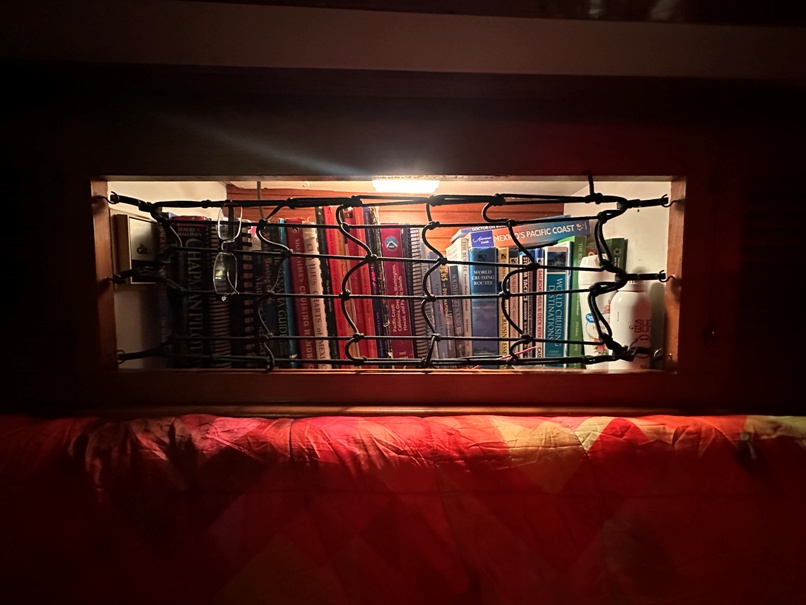
One of the things I inherited with La Sirena was her library.
It occupies a surprisingly large amount of space aboard, tucked into shelves behind the settee and secured, appropriately enough, with netting to stop forty-odd years of accumulated knowledge launching itself across the cabin when the boat heels.
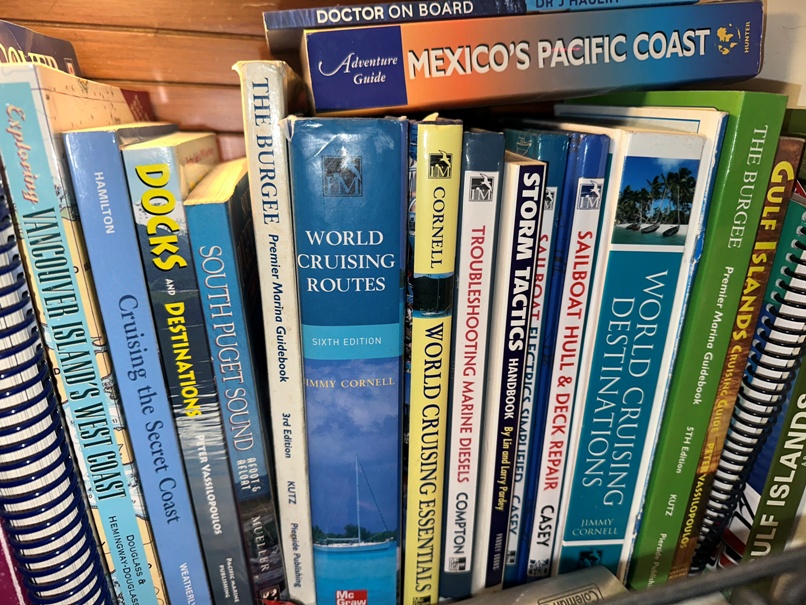
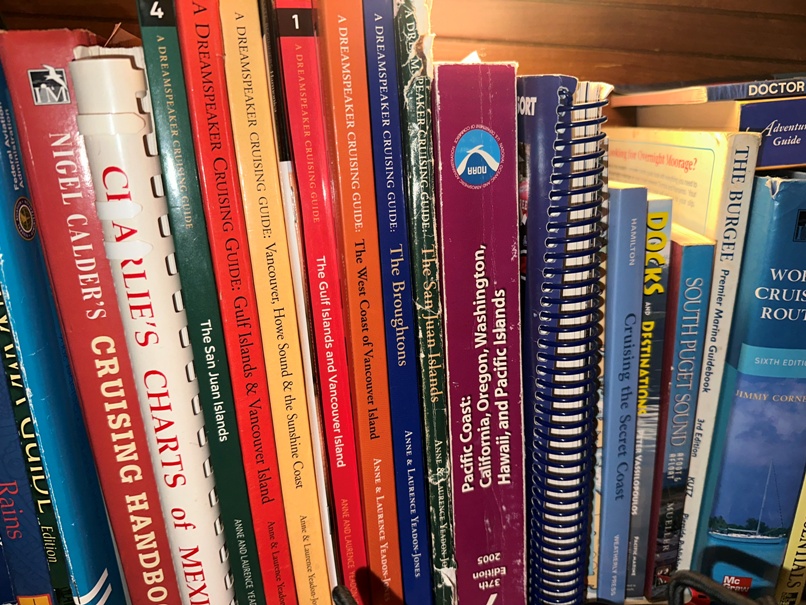
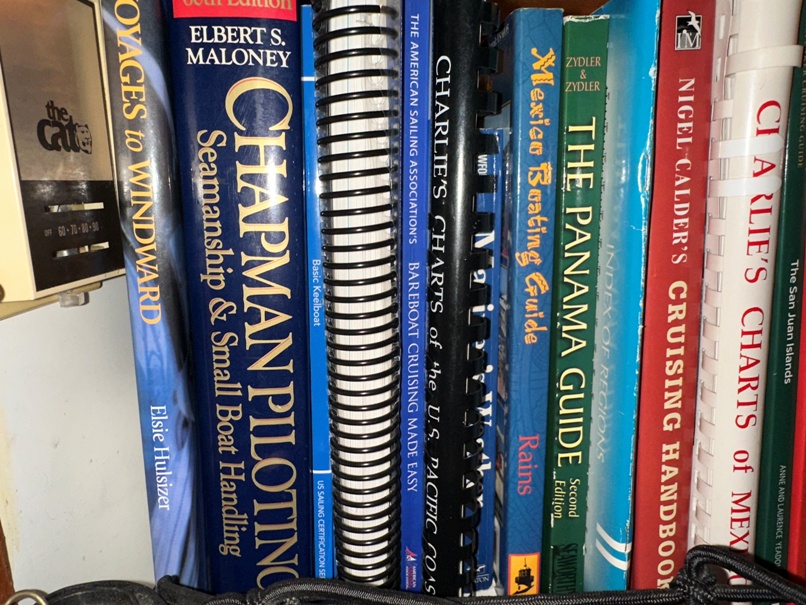
Some of it is immediately practical. There are books on diesel engines, electrical systems, communications, navigation, seamanship, weather, storm tactics, boat maintenance and repair. There are cruising guides and charts covering the waters of the Pacific Northwest, California, Mexico, the Gulf Islands, San Juan Islands, Vancouver Island and farther afield.
There are some wonderful old cruising books too: Jimmy Cornell’s World Cruising Routes and World Cruising Destinations, Nigel Calder’s Cruising Handbook, Chapman Piloting & Seamanship, Storm Tactics Handbook, World Cruising Essentials, Troubleshooting Marine Diesels, and an entire collection of Dreamspeaker cruising guides for the coast around British Columbia and Washington.
Some of them are dated. GPS, AIS, satellite communications and modern weather forecasting have changed cruising enormously since many of these books were printed. But tides still run through the same passages, rocks remain exactly where they were, diesel engines still require fuel, compression and air, and a storm at sea remains remarkably unimpressed by technological progress.
And then there is the other library.
La Sirena came with 46 years of receipts, manuals, instructions, diagrams and paperwork.
That may ultimately be more valuable than any single book aboard.
There are manuals for equipment that has long since disappeared, others for equipment still quietly doing its job decades later, and receipts documenting repairs, replacements and modifications made by people who cared for the boat long before I arrived. Taken together, they form something resembling an archaeological record of a 1980 Rafiki 35.
When I am tracing a wire, identifying a pump, wondering why somebody installed something in a particular place, or trying to understand a system that predates me by decades, somewhere in those folders there is occasionally an answer.
And that seems particularly appropriate aboard an old cruising boat.
I have spent much of this refit learning La Sirena by taking things apart, tracing hoses and wires, reading manuals, asking questions and occasionally discovering that what initially made absolutely no sense actually made perfect sense once I understood what somebody was trying to accomplish thirty years ago.
The books complement that process. They aren’t decoration. They are part reference library, part cruising inspiration and part emergency backup.
A phone can fail. The internet can disappear. Batteries eventually go flat. A well-thumbed book on diesel troubleshooting will still work perfectly at two in the morning in an anchorage when the engine won’t start.
And among all the practical manuals are books about places.
The San Juan Islands. Vancouver Island. The Inside Passage. California. Mexico. Panama. The Pacific.
Places La Sirena has been, places she may have passed before I knew her, and places that are still ahead of us.
So I haven’t been particularly enthusiastic about clearing the shelves and replacing everything with an iPad. I’ll certainly carry electronic charts, weather routing, digital manuals and all the modern tools available to me. But the ship’s library stays.
Because somewhere amongst those battered spines, handwritten notes, old charts and 46 years of receipts is something more than information.
I may get to add a few pages of my own.